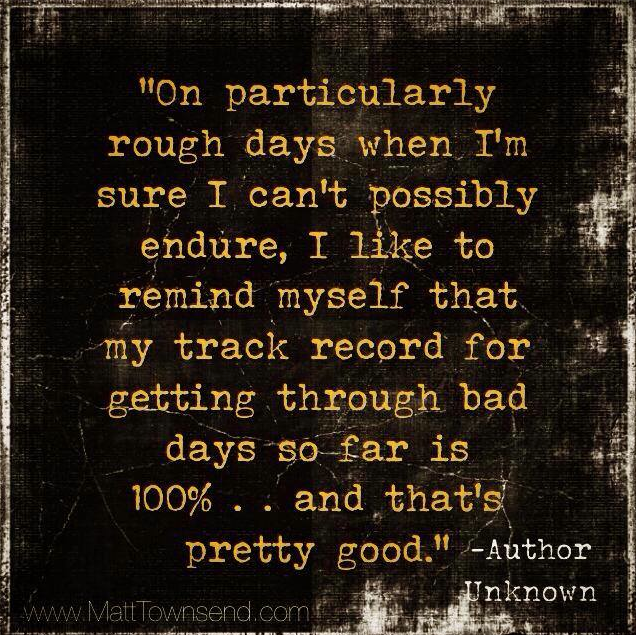
DEPRESSION…AND HAPPINESS

Is it possible to be both depressed and happy?  Common sense would tend towards no.  But I’m thinking that it is possible to be both, at the same time, without even being aware of it, especially if your ‘normal’ state is some degree of depression.  I think that depression runs the gamut from mild sadness occasionally all the way to severe clinical depression.  I cannot honestly remember a time that I was not depressed, though if asked now, I would say I am happy.  What does that mean?  Being happy?  Obviously, happiness is subjective.  What makes me happy will not necessarily make you happy, and vice versa.

I can remember clearly the first time I was aware that I really didn’t want to be in this world.  I was 14 years old.  As I am thinking about this, though, I suspect that this idea occurred to me when I was far younger.  I simply do not remember.  Much of my childhood is a blur. I have very few actual memories, but knowing myself as I do, it makes sense that it would have come up long before I was 14.  So much more is known and understood these days about depression and the genetic link.  I am definitely predisposed to suffering from it.  My brother and uncle (my mother’s brother) are both diagnosed bipolar.  I believe that my grandmother, though not diagnosed, also suffered from it.  And plain old depression runs rampant in my family.  Two of my brothers have died as a result of it.  It is something I continue to struggle with, though certainly not to the degree I have in the past.

I think part of the reason that depression is still so misunderstood and seen by many as some kind of weakness, is because it is possible to live with it and function almost normally.   I did it for many years before I finally took the antidepressants I needed to get my chemicals back in balance.  I’m sure I even had times that I felt happy in the midst of my suffering.   I remember when my grandmother found out I was taking an antidepressant, she said, “You’re not depressed.”  Ha!  I told her that just because she didn’t see it did not mean it wasn’t there.   I was very good at hiding it from everyone.  I knew for years, and other than a few attempts at therapy, I did nothing about it.  My mother’s attitude was, buck up and stop feeling like you do.  Oh, okay.  Too bad I didn’t think of that.  Unfortunately, that is the attitude of a lot of people.  If you were stronger you could do it.  It does not work that way.  If your chemicals are truly out of balance, no amount of wishing, hoping, talk therapy, exercise or anything else is going to change it.  You must get the help you need.  What made me finally break down and admit I had to go on medication was being in Key West, the sun shining and I was feeling nothing but darkness.  I thought, oh crap, my therapist is right, I do have to take something.  I was always able, when I lived in Chicago, to blame it on the weather and the lack of sunshine, which were definitely contributing factors.  But when I was in sunshine and warmth and still had such negative feelings, I knew the time had come.

When I got back to Chicago, I asked my therapist for a recommendation of a psychiatrist so that I could do what needed to be done.  When I first went to him (I do not even remember his name now) and he confirmed that, indeed, I needed medication, I asked how long I would have to take it.  He told me that usually a year, maybe a little longer was considered ‘normal.’  I said, “Okay, but that’s as long as I plan to take it.  No longer.”  He agreed, and I continued with my therapist and once a month saw him as well.  All I can really say about the drugs were they accomplished what needed to be done.  I have always described the process of being on them as hateful.  I was first prescribed Prozac, which just about killed me.  Every bad side-effect that was possible to get, I got.  Finally, he changed it to Wellbutrin and though I hated it too, it was not quite as bad as the Prozac had been.  In the end I took it for 14 months, and when I was done, that was it.  Luckily, he agreed, and I went off of it.  I felt better than I had in years.  At the time, too, I asked if I would ever have to take it again.  He told me that I might, that there was no way to really know, sometimes people did and sometimes they didn’t.  There have been times when I thought maybe I should probably be on something again, but until my attack, I never seriously considered it.

If you’ve been reading this blog all along, then you already know what happened when I attempted to take something for my depression, post attack.  Because I had had such a negative experience with antidepressants, even though they did help me, I really did not want to take one if I could somehow do it more naturally.  So, Suzie, my amazing therapist, recommended St John’s Wort, which is an herb.  I thought this was a suitable compromise.  Well, just as the prozac almost killed me, the St John’s Wort almost made me kill myself by jumping off the Coronado Bridge.  Thing is, I did not realize it was the pills, I just thought I wasn’t getting better.  I did not tell anyone, including Suzie, for a couple of weeks.  I finally told her and she immediately knew it was the supplement that was causing the problem.  I had to wean off of it, but because of that and the fact that every other thing I had tried taking and had had such a bad response to, I was afraid to try anything else.  I had to white-knuckle it the rest of my therapy.  As I’ve said before, my depression after my sexual assault was situational, not clinical, and I was able to do it.

Ask me if I’m happy now, and I’ll say YES.  Some times I am happier than other times, and I still have issues that definitely challenge me, but, over all, I am happy.  That’s my story and I’m sticking to it!
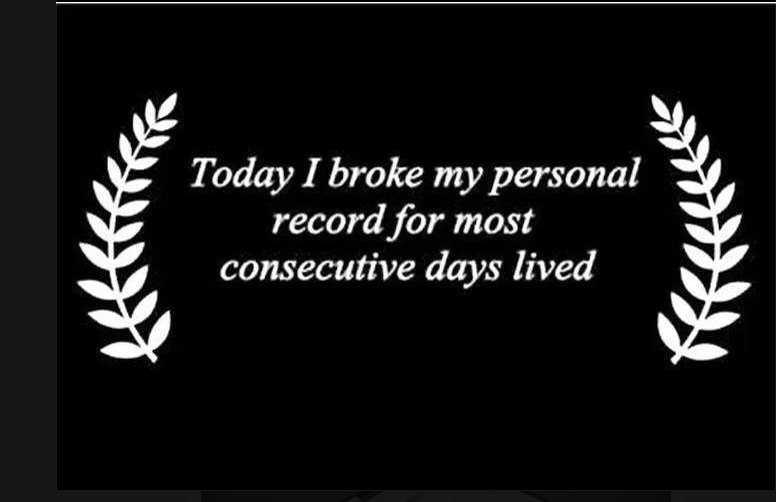
 

Screen Shot 2014-06-03 at 6.43.25 AM Screen Shot 2014-03-25 at 7.32.15 AM


MY LIFE STORY IN 100 WORDS

I got this idea from Jennifer Pastiloff’s post yesterday.  She featured a guest post by Elissa Wald,  who had been asked on an application for freelance copywriting work, to tell her personal story in 100 words.  (To read Elissa’s 100 word story, go to Jen’s web site, http://themanifeststation.net)

It got me thinking of what I would say in 100 words that could truly encapsulate and/or describe my life in so few words.  I mean, I’ve lived 54 years and been through an awful lot.  But I like a good challenge, so I gave it a shot.  I am calling it my life story as opposed to my personal story.  Here’s what I came up with:

My Life Story In 100 Words:

A happy, healthy, loving, kind, silly, adventure-seeking, funny, mostly intelligent, sometimes wildly irreverent, forward-looking spirit having a very human experience. Have faced many life challenges with grace, and survived. Have fought hard to stick around to see what happens next. Looking to make a difference in my life so that I am able, by example, to encourage others to do the same. Believe that one person CAN make a difference, and if we all live with this uppermost in our minds, think of the awesome transformation the world would see. Am ready for blessings that are no longer in disguise.

What do you think?  Did I do it?  Can you do it?  I’d love to see what you come up with.  Please leave a comment with your 100 word story.


A FINE LINE

I started writing this post last night on my phone.  I only wrote a portion of it because it is a bit of a pain doing it that way.  I need to be able to see the entirety of what I’ve written and that just isn’t possible on a tiny screen.  Reading over what I wrote, though, I think I’ll go in a different direction.  I was going to eventually tie what I wrote last night into what I really want to say, and it would have been a far longer, more complicated essay, so, I’ll leave that for another day.

What I really want to say today is there is a very fine line between teasing and being rude and disrespectful.  I grew up being teased, and though I am not always crazy about it now, I do understand it, and it is familiar.  And, to a point, I am truly okay with it.  However, it simply does not work for me in the ways it used to.  Was it my attack that has made me more sensitive to this?  Is it evolving and changing to a kinder, more loving person in general?  Or is it not being willing to put up with any crap and rudeness of any kind anymore?  It’s probably a combination of all of those things.  And, really, it doesn’t matter what the reason…if I perceive it as something I do not want in my life, I have every right to feel the way that I do, and to do whatever I need to so that it stops.

At the risk of being called overly sensitive and/or ridiculous, I had an incident occur on the 4th of July that upset me.  A LOT.  A little background…I drive an old car.  Her name is Grazelda.  She is a ’96 Volkswagen Golf, the Harlequin edition, which is a multi-colored car.  It is one of the rarest Volkswagens ever made. There are only 70 of my version.  Most people love my car and think it is really cool.  Okay, so she is faded and has some rust on her hatchback.  So what?  The thing is, you do not have to like my car, and, frankly, I don’t give a damn whether you do or not.  What I have an issue with is you telling me that I drive a piece of shit car or that no one wants to be seen riding in it, etc.  Yes, these comments and others like this were made to me on Friday.  The sad thing is they were made by someone I’ve known since I was 18 years old (36 freaking years!) and not for the first time.  And as if that wasn’t bad enough, I have two family members that jumped on the let’s-bash-Tamerie’s-car bandwagon.  The seem to think it is cute.  I do not.  Not even a little bit.  And these relatives are not young teenagers or even twenty-somethings; no, they are in their sixties!  Of course, this behavior is nothing new and something I have put up with for as long as I can remember.  I do know they care about me and are just teasing me, and in spite of that, and in spite of my asking that they not do it, they continue to do so.  It makes me not want to go to family functions.

Am I being a big, fat baby about this?  I don’t think so, and even if I am, their behavior lands on me as disrespect.  And that I should not have to tolerate, especially from people in my family.  As for my friend from college, that’s an entirely different story.  And why, would someone please explain to me, are there people who think it’s okay to give me their opinion about my car, especially when it has happened numerous other times, and I have made clear that I do not appreciate nor want to be subjected to it?  To me, this is extremely rude and so uncalled for.   It has been suggested that this is his way of letting me know that he likes me.  Really?  Really?  Grow up.

I have always been a person who stands up for myself.  I have never cared if others like me or not, nor have I cared what they think about me.  If you don’t like me, okay.  I see it as your loss more than anything else.  I would never tell anyone, ANYONE, the things that certain friends and family members feel they have the right to say.  I learned a long time ago that words can never be taken back.  Oh sure, you can apologize for saying something hurtful or mean or down right cruel, BUT you can never take it back.  It can’t be unheard.  Because of this, I am very careful what I say to others, and even more so if I am angry or upset.  I am not sure why others are not as careful.  It seems like such an easy and kind thing to do.

A PAIN IN THE NECK

Make that a pain in my neck.  Literally.  In this ongoing, seemingly never-ending process of healing from my attack, when most everything has been dealt with and is, if not totally better, pretty dang close, the one thing that is still hanging on is the pain in my neck.  And, for the most part, it’s okay.  But not healed, and this is an issue for me.  As my soon-to-be-gone (moving out-of-state – boo hoo) acupuncturist, Matt Truhan, said a couple of weeks ago, my neck was the first thing injured and it is the last thing my body is hanging onto.  Immediately following my attack, I could not move my head at all.  I had to turn my entire body to look at something behind me.  In time, I was able to move it again.  Two or three months?  I do not remember exactly, but, eventually I was able to move my head without turning my whole body.  And because I was so focused on healing the emotional trauma, my neck was kind of forgotten about.  Or, rather, I just learned to live with the constant pain, and after a while, even though it was, and is, still there, I ceased noticing it. Kind of like the headaches I used to suffer from.  In my daily life, for the most part, I am not aware of it.  In yoga, though, I am very aware.  There are certain postures I simply am unable to do because my neck will not bend or turn.  Even when my teacher says, as we are on our stomachs, ‘turn to your favorite cheek,’ I have to keep my head straight, there is no turning to either side more than just a couple of inches.  Or when we are in a twist and he or she says to bring the head back to center, and mine has been there all along.

So, as a last-ditch effort before he and his wife move to Oregon, Matt has been concentrating on my neck.  It has helped, but I’m not sure it will be all better before he leaves.  Because I do not like massage, he never insisted on working on it before.  Oh, he put needles in it and in other points that correspond to the neck, but the pain and lack of mobility is as much muscle memory as it is real, physical pain, and that makes it much harder to deal with.  The massage, though very painful, has helped some.  This last Tuesday, though, I was exceptionally sore because I had played tennis for the first time in 6 years, and he did insist on a short, Chinese-style massage.  The reason I do not like massage is because I always feel awful afterwards, like for several days.  I agreed because he is so good at his job and I thought, maybe, it wouldn’t be so bad.  Wrong.  Not only did it hurt, I felt like crap the rest of the day on Tuesday and still felt yucky yesterday.  I even took an epsom salt bath, which I dislike almost as much as massage.  Today, I feel almost normal, whatever that is.  And when I say I feel almost normal, I mean from the ill-effects of the massage, not my neck.

The dictionary on my computer defines whiplash as:
whiplash |ˈ(h)wipˌlaSH|
noun
1 [ usu. in sing. ] the lashing action of a whip: figurative : he cringed before the icy whiplash of Curtis’s tongue.
• the flexible part of a whip or something resembling it.
2 injury caused by a severe jerk to the head, typically in a motor-vehicle accident.
verb [ with obj. ]
jerk or jolt (someone or something) suddenly, typically so as to cause injury: the force of impact had whiplashed the man’s head.
• [ no obj. ] move suddenly and forcefully, like a whip being cracked: he rammed the yacht, sending its necklace of lights whiplashing from the bridge.

In my case,  it was both a noun and a verb.  I sustained injury ’caused by a severe jerk to the head’ though mine was from being violently slammed to the pavement, and not by a car accident.  And the action of DCD in slamming me to the pavement caused the injury.  Even now I get a twinge of pain and sadness when picturing the scene that morning.  I know it could have been so much worse.  Had I not been in such great physical shape and been so angry that someone would even think of attacking me, the outcome may have been far different.  And yet 33+ months later I am still dealing with the pain that his actions caused me that September morning.  That pisses me off.  And makes me even more determined to get myself completely healed, however long it takes.

YOGA AND HEALING

I started doing yoga in September of 2011.  While it is true that I had taken a few classes here and there, I never ‘got into it.’  However, when I took my first class at Coronado Yoga and Wellness, something clicked.  I will admit that during the first class, I thought, ‘this is so slow, I’m not sure I can do this.’  Then I admonished myself to relax and take it for what it was, that I didn’t have to go 100 miles an hour to benefit from something.  That did it for me.  I had had only 2, maybe 3 classes, when I was attacked.  I kept going back, though, even as my body and mind were in shock, and I had to be around people, and at that point, I was afraid of all people, I kept going.  I remember lying on the floor, wanting to cry and not being able to, going over and over in my mind what had happened and still not believing it had actually happened to me.  And even though my body was hurting, I continued to show up.  There is not a doubt in my mind that doing yoga was instrumental in my healing process.

I came upon this wonderful essay about just that and I emailed the author, Molly Boeder Harris, to ask if it was okay for me to reprint it here.  She graciously agreed.  She also has a web site that deals with sexual assault, www.thebreathenetwork.org.


Transcending the Trauma of Sexual Violence With Yoga
By Molly Boeder Harris
Photos by Michael Rioux

“Sexual violence can impact every facet of a survivor’s life, including her physical, mental, and spiritual health. Philosopher Ann Cahill captures the pervasive nature of the crime of rape in her book Rethinking Rape (2001), explaining, “As a traumatic, violent, embodied experience, rape…does not merely attack the victim’s sexuality, or her sense of safety, or her physical being. It does all of this, and more. It cannot be assumed that there is one aspect of that person’s being that is untouched by the experience of rape. There is no pristine, untouched corner to which to retreat…the extent of the rapist’s influence is broad, but not infinite…the self that emerges from the process of healing will always be qualitatively and profoundly different from the self that existed prior to the assault. To know oneself.as raped, is to become a different self.”
Healing after sexual assault requires intentionality, consistency, and patience. The challenge of swimming against unexpected waves of physical, emotional, or spiritual disturbance and depression, combined with a cultural expectation that time heals all wounds, can leave survivors feeling disconnected from themselves and others and unable to trust their ability to manage their inner experience. The nonlinear and often lifelong process that begets healing can cause survivors to question their capacity for resilience.
Yoga provides an accessible, personalized practice that can engage survivors in safely processing sensation and sustain them through multiple stages of healing. Like healing, yoga is a lifelong practice , with ebbs and flows, breakthroughs and setbacks–all equally valuable and necessary. For a sexual assault survivor, an intentional yoga practice provides a safe, accessible, and self-directed space that serves to reintegrate body, mind, and spirit. As survivors explore layers of their being and allow sensation to emerge, pain and suffering are alleviated, and more space is created for encountering the awesome experience of being alive. Yoga allows survivors to regain a sense of comfort and ease within their own shape, to process nonverbally feelings that transcend language, and to experientially cultivate gratitude towards the body, which serve as a reminder of one’s resilience.

In practicing yoga, we link movement with breath and a presence of mind, offering a welcome inner quieting and release of tension that foster expansion. Yoga creates a unique environment where survivors can explore inside with kindness and inquisitiveness and develop attitudes that allow for compassionate responses. Honoring the body as a sacred space after surviving the violation of rape demands tremendous, consistent effort, but the integrated healing it provides remains unparalleled.
The belief that humans (and animals) contain an innate healing capacity–accessed through the body–is a guiding methodology in contemporary trauma treatment. Dr. Peter Levine, creator of a “body-awareness approach to trauma” called Somatic Experiencing ® , describes how our “instinct to heal [and] self-regulate [are] engaged through the awareness of body sensations that contradict those of paralysis and helplessness, and which restore resilience, equilibrium and wholeness.” Levine’s body-based method ” returns a sense of aliveness, relaxation and wholeness to traumatized individuals who have had these precious gifts taken away.” Pat Ogden, another trauma expert, describes the value of mindfulness, an integral part of her body-based psychotherapy practice, as a “state of consciousness in which one’s awareness is directed toward here-and-now internal experience, with the intention of simply observing rather than changing [the] experience.” Ogden eventually encourages the individual to “come out of a dissociated state and future or past-centered ideation and experience the present moment through the body.” This holistic system brings ” the body experience into the foreground” and offers the possibility for profound healing. The essential threads within these innovative techniques, such as body awareness, examining internal movement of feeling and sensation, staying present in the “here and now,” and bearing witness to one’s experience without judgment are qualities that rape victims can weave into a balanced, intentional yoga practice.
Since sexual violence often damages the connection with the body, body-based therapeutic practices are invaluable. Discussing the layered impact of trauma, which can heighten negative sensation and hinder positive sensation, Ogden describes how ” fully experiencing sensations may be disconcerting or.frightening, as intense physical experience may evoke feelings of being out of control or.weak and helpless. On the other hand, traumatized individuals are often dissociated from body sensation, experiencing the body as numb or anesthetized.”
Yoga postures, breathing exercises, and meditation techniques can effectively reduce the symptoms of rape trauma syndrome (RTS), a form of post traumatic stress disorder that was identified by Ann Wolbert Burgess and Lynda Lytle Holmstrom in 1974. RTS includes symptoms and reactions experienced by most survivors during, immediately following, and for months or years after the assault. RTS can involve psychological, physical, behavioral, cognitive, and interpersonal disruptions including headaches, anxiety, inability to concentrate/focus, sleeplessness, lethargy, anger, depression, mood irregularity, spiritual disconnection, hopelessness, fear/avoidance of intimacy and sexuality, eating disorders, self-injury, and substance abuse. Survivors navigate amidst hyperarousal, numbness, and vivid nightmares, causing a host of energetic imbalances and concerns.
Survivors may experience flashbacks upon some sort of sensory trigger, in which they feel as if the assault is happening all over again–and the physical and emotional responses can be quite visceral, if not debilitating. The embodied practice of yoga allows survivors to develop healthy coping and grounding techniques that can disrupt a flashback and reestablish stability. Since flashbacks may also happen due to perceived or real threats, this ability to track body sensation, which helps survivors experience present reality rather than reacting as if the trauma were still occurring is an essential tool to self-care, independence, and personal safety.

Given the challenges that individuals must brave after surviving sexual assault, it is clear that a comprehensive yoga practice involving organic movement, exploring sensation, intentional breathing, and deep rest can aid healing. A survivor benefits from the internal cleansing and freeing feeling of a vigorous vinyasa practice, as well as the profound comfort and spaciousness that accompanies a restorative sequence. The yoga practice can be tailored to support and enhance a survivor’s sense of embodiment, integration, and inner peace.
When the poet Adrienne Rich describes the healing power of poetry, it reminds me of the mysterious and boundless gifts that yoga can bring into a survivor’s life: “[I]t has al ways been true that poetry can break isolation, show us to ourselves when we are outlawed or made invisible, remind us of beauty where no beauty seems possible, remind us of kinship where all is represented as separation” (“Defy the Space That Separates,” The Nation , October 7, 1996). W e are all essentially survivors, carrying the stories and scars of our Life’s path. Some of those scars still hurt us deeply, yet others have transformed us and informed new and beautiful journeys. As we trek along our paths of healing and growth, let us offer gratitude for the exquisite opportunity to discover embodiment, breath by breath, this precious and simple offering that the practice of yoga returns to us.”


I continue to do yoga 3-4 days a week, mostly yoga on the beach here in Coronado or outside on the grass in Pacific Beach.  It has made me stronger in all ways and I will have a yoga practice for the rest of my life.  I wish I had found it earlier in my life, but am incredibly grateful it came when it did.  It contributed greatly to the healing of my mind, body and spirit.

FORGIVING DOES NOT MEAN FORGETTING

Still working on forgiving – my attacker, of course, and even more importantly, myself. I know it seems strange that I would in any way need to forgive myself for something I did not do, for something I never would have wished upon my worst enemy; not that I really have any enemies, but if I did, I wouldn’t wish a sexual assault on them.

In April, right before I left for a trip to Atlanta, to visit my parents, to go to the Masters and  to Saint Simons Island to visit my friend Kim, I was on my way to the outlet mall down by the border and passed a sign for the exit for Donovan. I have never noticed this exit before on any previous trip. When I saw it, the thought that popped into my head was, “I should go and visit DCD.” (A friend wrote me to tell me that I need to stop calling my attacker ‘cockroach boy’ and start using his name. While I agree that CRB isn’t very nice, what he did to me wasn’t very nice and the best I can do right now is call him by his initials.) And then I thought, ‘Whoa, where did that come from?’ I completely forgot about it until my last Hoffman gathering. Well, after doing some research, I found out that DCD is not, in fact, housed at Donovan, but at Kern Valley, which is about a 4 hour drive from here. And in order to visit a prisoner, you have to be on the approved visitor list and the person to approve me is DCD. You actually have to apply to be visitor, and even if DCD said it was okay, the prison system has to okay it, as well. I think my real reason for wanting to go visit him is to ask him WHY? I’m not sure I’d even get an answer and even if I did, it may not be one I want. I’ve thought about it a lot and come to the conclusion that going up to Kern Valley State Prison is not something I am prepared to do. A compromise may be to write him a letter. Again, I am not sure what I hope to really accomplish with this. I may end up writing him and not sending it.

At acupuncture last week, I was lamenting about how long the healing process is taking. Matt said to me, ‘You ARE through it. Right now. You are done.’ Okay, cool! Maybe it really is as easy as that. Yes, I am still dealing with some physical issues that have occurred as a result of the attack. Each day, though, I feel like I am one step closer to being completely healed. Will I ever forget about it? Doubtful, especially since I write about it. Will there always be certain things that are either very difficult or impossible for me to do? I have no idea. Only time will tell.

Whatever the case is for me, however it plays out for me in the future, forgiveness has been on my mind a lot in the last 2 1/2+ years. So as for forgiving myself, just as with DCD, I am much closer than ever to being able to say honestly that I have done it. I am not sure why I blame myself on some level, and I may never understand that. Don’t get me wrong here, I am very clear that I did nothing wrong, that the way I was dressed had nothing to do with it, that I was in the wrong place at the right time, because, to my way of thinking, if it had been the wrong time, it never would have happened. As I have said before, too, I do believe that it happened for a reason and though I did not specifically ask to be sexually assaulted, I had been asking for changes in my life. I am really okay with all of that, which is why it baffles me that I would in any way blame myself. Yet, it is still there to a degree. Clearly, I will be done when I am done. There doesn’t seem to be a way to make it go faster. It will take as long as it takes.

Because forgiveness has been so much on my mind, when the topic for the 7 March 2014 daily reading in my Science of Mind magazine, written by Joanne McFadden, was FORGIVE, this was just another validation that I am on the right path. I loved the essay so I am going to copy it in its entirety:

“After Olympic runner Louis Zamperini’s plane went down in the Pacific in World War II, he and the pilot floated for forty-seven days on a life raft. They survived a strafing attack by a Japanese pilot, numerous shark attacks and a lack of food, only to be captured by the enemy. They were brutally beaten, subjected to medical experiments, starved and worked to near death as prisoners of war. One guard, nicknamed “The Bird” by prisoners was determined to break Zamperini. Maintaining humanity and dignity was a daily struggle.

Zamperini survived. However, nightmares of his ordeal kept him emotionally imprisoned for years after the war, plunging him into alcoholism and despair. At first, Zamperini was convinced that vengeance was the only way to reclaim his life, and he became obsessed with it, making plans to hunt down The Bird. Grace intervened. Under protest Zamperini attended a Billy Graham meeting. He was about to get up and leave when he remembered a bargain he made when his raft floated in a dead calm. If God would save his life, Zamperini would serve.

That recollection changed his life dramatically. Zamperini forgave The Bird and went on to create camps for troubled boys, sharing his experiences and showing them a different way of life.

When I have allowed myself to have something to forgive, I like to remember extreme examples like Zamperini’s. If he could do it, so can I.”

Exactly. If Louis Zamperini can do it after the unimaginable things he endured, then so can I.

“It’s a healing, actually, it’s a real healing…forgiveness.” ~Louis Zamperini

THE ‘SIDE EFFECTS’ OF HOFFMAN

As I have already stated, doing the Hoffman Process, literally, saved my life.  Just as my last three posts were titled, it was a huge leap of faith for me.  It was truly an experience like none I had ever had before, nor have I done anything like it since.  I am forever grateful that I was able to find it when I did, that I had a very supportive (soon to be ex) husband and that I had the resources necessary to do it.  My life so completely changed afterwards.  Something very fundamental shifted in me.  It was clearly something that needed to shift.  BH (before Hoffman) I was a very pessimistic person.  Even after having ‘done’ the antidepressant drugs and therapy, there was still something not quite right in me.  It is very difficult to explain how I was different, why I felt so much better, though I will do my best.

When I left to drive back to Chicago, the world seemed somehow brighter.  I felt more alive, like every part of me was happy.  That feeling in itself was odd for someone who had been perpetually depressed and unhappy for most of her life.  Depression is a weird and insidious thing.  It’s not that I had a bad life, quite the opposite, but I never felt that good, let alone great, and certainly not happy.  Okay, maybe on occasion, for a short amount of time, I felt okay, or good enough to keep me going.  Believe me, that is no way to live, and, yet, I know many people do it, day in and day out, for their entire lives.  So, on my drive, I noticed something very strange: no more road rage.  None.  It was all gone, and it stayed gone for a good 9 or 10 years.  Sadly, it has started creeping slowly back in.  It’s not bad, certainly not like it used to be, but I do find myself getting mad at other drivers.  I have to make a real conscious effort to relax and realize that no one is purposely ‘out to get me.’  It was nothing I consciously decided to rid myself of, it just happened as a result of doing the Process.

For years, as long as I can remember, I have always had headaches.  When I was a teenager, I suffered from migraines that appeared every 6 weeks or so.  They did not seem to be connected to my periods, but they did show up just as regularly.  The worst one I ever had lasted 13 days.  Yes, THIRTEEN DAYS!  My (physician) mother finally took me to the doctor to see if there was anything that could help.  The doctor wanted to test my tolerance to pain (clearly I had a lot) and did so by giving me a shot in my hip.  I could tell that the needle was tiny, but it hurt so much that when he told me he could give me another shot that would make my headache go away in 20 minutes, I said, “No way!”  My thinking was I had had the headache for 13 days so it was bound to go away soon, even without a shot.

The really bad thing about my migraines as I got into my late teens and early 20s was how they affected me.  I had blind spots in my eyes and when I would look at a person, I could not see his or her face.  Everyone was headless.  This was a real problem when I was driving.  Not only could I not see people’s faces, now I couldn’t see whole cars.  I would have to pull over, carefully, and call someone to come and get me.  Over time, the migraines eased up a bit, but I still had regular headaches.  I rarely did not have a headache.  There was always pain, but I was so used to it, I mostly ignored it.  I have probably taken enough aspirin, Tylenol, and ibuprofen in my lifetime to kill a herd of elephants.

Very unexpectedly, AH (after Hoffman) my headaches were gone.  Completely!  I had no pain at all in my head anymore.  As far as side effects go, this was a great one.  13 1/2 years later I rarely get headaches, and if I do, it’s because I really have a pain in my head.  All the headaches I suffered for all those years were, apparently, stored and repressed anger, and once I dealt with the underlying causes of that, they had no choice but to disappear.

I always had a potty mouth.  Not horrible, but not so nice, either.  I had read a book by Hugh Prather in the early 90s called “Notes To Myself.”  I do not have the book in front of me, so I cannot quote it exactly; but he said something to the effect of ‘when you swear, all I hear is the swear words and not what you are trying to say.’  At the time I had boyfriend who like to yell and swear and that’s all I could hear.  So, even then I was doing my best to be more conscious of not swearing.  Let’s just say, I wasn’t that successful at it.  AH, though, that all changed.  I was doing something and felt the need to swear.  When I opened my mouth to say, oh, who knows, ‘shit’ or ‘fuck,’ out of my mouth came, ‘oh, bother.’  I just started laughing.  To this day, I rarely swear, and when I do, it is way more effective.  And, really, I think it sounds crass to have every other word come out of your mouth be a swear word.  I will admit, I sometimes do swear when I am alone, especially if I am angry or frustrated at something or someone.  But, like I said, I hardly ever do it in front of anyone.  I have friends who have said they have never heard me swear, and that’s a good thing, I think.

These are just three of the ‘side effects’ I ‘suffered’ as a result of doing the Hoffman Process. All are good and all helped to improve my life, I’d say.  There are so many more, some big, most small, that I wouldn’t even be able to list them.  The entire 10 days was such a life-changing experience.  There are hundreds of Hoffman graduates in the San Diego area, and we have monthly gatherings to continue to work the tools we learned, and to stay connected to each other.  I know Bob Hoffman (founder of the Process) is smiling down on me.

A LEAP OF FAITH, PART 3

The following is the second half of my Summary of the Process, written on 18 November 2000:

My experience with the Emotional Child/Intellect/Body/Spirit confrontation and Truce was actually fun.  (Again, a lot of what I am writing about here will make no sense in the specifics unless you have done the Hoffman Process.)  All parts of me felt good that they were finally able to have their say, to actually be heard and to know that what each part felt and said was, and is, important.  All parts of me now realize that we all must work together, that no one part has more of an important role than any other, that we must all listen carefully to what is being said, and act accordingly.  The truce was a validation that we will continue to be there for, listen to and work with each other, all our parts, from that day forward. I found the recycling to be useful as a tool to get rid of negative thinking and patterns and to look at those patterns in a new way.  Some of the alternatives that came up seemed a bit silly, but, perhaps, that’s really the point.  In the end, the idea is to eradicate those patterns that impact negatively in my life and if rolling in a field of sunflowers, whether physically or only in my mind, does this, then it must be a good solution. My experience of expressing my vindictiveness and then finding forgiveness had a sense of being free of the need to lash out and try to get back at people for the perceived slights or hurts inflicted upon me.  Again, in the end, I am the only one hurt by carrying a grudge and feeling that sense of superiority or self-righteousness.  It felt good to let go of those feelings and the feeling of trying to show you that I am better because I am paying you back for hurting me, that I’ll show you.  The need to always be “right” has disappeared.  I’ve always felt that people should live and let live, but in reality, I didn’t actually practice it.  I thought people should live and let live, but by my rules, by doing it my way.  Now I feel able to actually practice what I preach, so to speak.

My experience with writing the Positive Letter to my parents isn’t complete yet since I haven’t finished the letter.  With what I’ve written so far and with all of the good thoughts I had surrounding it, though, I feel it’s a good thing to be able to think of both of my parents in positive terms instead of as all negative patterns.  And though at times it has been quite difficult to see, I do know that I did learn the virtues and strengths that I have, even if I don’t always recognize them as such, from them.

I have to say that play day was the most fun I’ve had in a long time.  The play session made me want to join, or if none is available, to start my own “Adult-Play Group,” just like those that exist for kids.  All the different games were so much fun and like one of my fellow Hoffmates mentioned, none lasted too long.  We didn’t have time to get bored before we were off to another game and/or adventure.  I especially liked the counting by 4s and then each number was given an animal and we had to find our other members with our eyes closed, of course.  It was all fun, though.  The magic carpet ride to the North Pole to visit Santa Claus was so cool.  It was an affirmation that I am a good and loving person since Santa doesn’t give gifts to bad people.  I don’t honestly remember going to visit Santa as a child, so it was a chance to experience something I wasn’t able to so long ago. It was great.  And so was the birthday party.  Although I do not remember such a large and elaborate party for me, it was a wonderful celebration.  I felt we were celebrating all that we had accomplished thus far in the week.  And to top it all off, we got to put on a play, just like kids love to do.  I don’t think the content of our play would ever show up in a play put on by actual children, but it was fun, nonetheless.  It gave us a chance to work together with each other.  Overall, I thought it was hilarious and showed what we can do when we put our heads, and hearts, together.  All in all, it was one of the best days.  I was truly sorry to see it end.  It felt kind of like when I was little and not wanting to go to bed because I was having way too much fun.

The next day we went back to the ‘hard’ stuff.  My experience with the Dark Side Process left me with a feeling of hope and calm.  And a determination to never let my dark side back into my life.  I know there will be times it’ll creep up on me, but I feel like I’ll be able to zap it and keep it from taking over.

I believe that if I am willing, and I am, to really listen to my spiritual self, I will never be led astray.  I know, without a doubt, that my spiritual side is very powerful.  I know that she has kept me alive for 40 years so that I could get to the place I finally am.  Even when I couldn’t see past the pain, she could.  I know, too, that she is a very loving and giving part of me. As I’ve always been a very visual person myself, I know that she must also be, since, really, we are one and the same.  She has helped me in the last several months, but especially in the last week, visualize my future.  And it looks good!

As I approach the end of the Process and prepare to go fully back into the world I left, I know that I can do it.  I feel so grateful that I’ve had this opportunity to grow and experience the last week, however painful and hard it was.  I am excited about what the future holds for me.  I am also a little bit scared.  I’ve got some major stuff to go through with J, but I KNOW I can face whatever comes my way.  I have the tools and the willingness to do it right, to keep the negative love out of my life.  I also know there will be pain and stumbling along the way, but nothing that love and my belief that I’ll come through it can’t handle.  I am free.  I am love, and I am lovable.


Okay, back to present day…just typing this out has been eye-opening.  As I said in one of the previous parts of this, I have not read or even looked at this stuff since I finished the Process in November of 2000.   One of the most powerful things that happened at the end of my time in Wisconsin, was opening my eyes and seeing all the past graduates who had come to participate in a particular ceremony we had, and knowing, I mean really knowing, that no matter what, no matter where I went, or what I did, for the rest of my life, I had a community of like-minded people.  And that alone was worth it.

LEAP OF FAITH, PART 2

I wrote the following on 18 November 2000:

Summary of My Process

Before actually beginning, or even being aware that such a possibility existed, my little voice that over the years, I believe, has kept me from doing anything I would truly regret, was once again screaming, and I do mean screaming, at me to listen.  It started in August, and, as usual, at first I discounted what it was saying.  I just couldn’t believe it was true.  However, over the course of a few weeks of really listening to and thinking about what had been said to me, I realized it was right.  A chance rental of the movie “28 Days” got me thinking that rehab was exactly what I needed; something so intense and concentrated that I could not walk away.  I asked my therapist if such a thing existed since I had never heard of it for emotional issues, only chemical ones.  She told me that, yes, she did know of a place called the Hoffman Institute that had a branch in Wisconsin and that she much respected the work that they’ve done.  She got the number and I called that day to have the information sent to me.  It didn’t arrive for a week and a half, which stressed me out since I wanted it instantly.  Once, in my own mind, I’d made the decision that it was for me, I wanted concrete facts in from of me.  I wanted to know when and where and how much.  When I finally received the packet, I glanced over it, and my first thought was, oh, this isn’t me for.  J read it more thoroughly, and later that evening, he told me he thought it was perfect for me.  I re-read it and began to think that maybe he was right.  Still, I had my reservations so I asked Cate the next time I saw her.  She again told me that she thought it would be very good for me.  I thought about it a little more, then made the decision to do it.  I called and made the reservation.  After that, I felt a little scared and a little excited, too.  The next day when Fed-Ex brought my enrollment package, I wondered what I had gotten myself into.  I knew, though, that I had to do it.  I felt, really, as though my life truly did depend on it.  I had made a promise several years earlier to my mother that I would not kill myself, but my spirit (which I know now, saved my life) was dying.  I was dying, and if I didn’t do something drastic, my life would cease to exist in any kind of meaningful way.  The time had come to take real action or I was finished.

A note before I continue — some of what I will be copying won’t make a lot of sense, unless you’ve actually done the Process, but it is more the feeling of what I’m saying than the specifics of what we were doing in the Process.  Also, because I wrote a little over 7 1/2 pages, I will break this into a Part 3.  You have to remember this was 2000, and laptops, if available, were not readily used, so everything was written by hand.  Of course, I still write in my journal by hand – no keeping it on my computer or iPad.  Okay, back to the summary of my Process:

My experiences in the Light Journey, my spirit guide, Child, Intellect and Sanctuary were all so foreign to me.  At the end of the visualization, I was more exhausted than anything else.  I also felt a sense of fullness, that here are parts of me I never even suspected existed, let alone knew of.  I felt as though a lot of missing, very scattered pieces came together at last.  I saw lots of colors swirling around and was amazed at the beauty of it all.  At times it felt awkward as my emotional child has never had that kind of love and attention that my spirit was paying it that day.  After I was able to put those feelings aside, though, I felt very grateful that I could help my emotional child feel loved and whole.  My intellect has done a good, no, make that a great job of helping me deny my true feelings about most everything in my life.  Having to allow my intellect to actually feel was liberating.  It gave me hope.  It made me feel as though I CAN DO IT.  Whatever IT is.  The vision of my sanctuary was very beautiful.  The was a huge hammock that my trinity came together in.  A place where the sun always shines, even as a gentle rain must sometimes fall to water the giant live oaks that support my hammock.  At the end of those visualizations,  I felt relief.

I think some of the most destructive patterns I learned from the major females in my life are self-doubt and never feeling good enough, and a sense that joy and happiness are for other people, not for us, or me. After dis-identifying with those patterns through the exercises we did, I felt a sense of freedom and forgiveness.  And relief that I am not the patterns I learned.  I felt that there is hope.

My experience of using my addictions in the Light also provided hope.  I realized that my addictions were, and still can be if I let them, just ways in which I isolate myself from everyone, including myself.  It has to be a conscious decision, daily really, not to allow it to happen.  In my fantasies, isolation is a wonderful thing, but in reality, it doesn’t really provide anything useful to my spirit or soul.  It actually keeps me from the very things I truly crave: love and a sense that I do belong, that I do, in fact, matter.

The most devastating and destructive patterns I learned from the male presence, or lack thereof, in my life are fear of men, of love, of being abandoned and of commitment.  My experience of dis-identifying with all those patterns through the exercises was similar to that of the female energy.  I also felt a profound sense of relief and lightness.

The compassion session was a sad, but incredibly moving experience.  For as long as I can remember, before this week, I have never viewed death as anything other than freedom from pain and the shitty word we live in, and because of that, it turned out to be harder than I would’ve imagined.  What made it ‘real’ was going to the cemetery and re-living it again there.  That was extremely difficult.  For me, just walking into the cemetery was hard enough, but what we did in the actual exercise was very real and sobering.  I still don’t believe that death is a bad thing, but I can finally see reasons for sticking around now.

Okay, this is where I am going to stop with the summary today.  I have not read this since I left Hoffman and it is kind of hard to take in.  I can see so much more clearly now, and I am able to see just how close to the edge I really was.  Scary!  The good news is I came through it and even now when I start feeling less than good, I have the tools to get myself back to where I need to be, where I prefer to live my life.  I learned so many of those tools at Hoffman, and as I have already said several times, Hoffman truly saved my life.

A LEAP OF FAITH: Part 1

I met my friend Shannon in 1988, while living and working as a model in Greece.  In 2000, I went to visit her in Vancouver, where she is from, though she lives in Barcelona now with her husband and two sons.  On the way to the airport I kept saying to my (then) husband, “I don’t want to go.”  He said, “Of course you do.  You always say this before you are leaving on a trip.”  True.  Did I know something subconsciously?  Did I sense that this trip would change the course of my life?  Maybe, but maybe it was just me not wanting to leave my comfort zone, the comfortable bubble I existed it at the time.  Whatever the case was, I did go on my trip, and my life did change.

As I said before, I had known Shannon since 1988.  I had met almost everyone in her family, everyone, that is, except her youngest brother, who I will call D.  When I met D I had a physical reaction to him.  This was strange because he was not my ‘type.’  He was tall and extremely fit, he participated in the Scottish Highland games and was really attractive. So what in that description is not my type?  All I can say is he just wasn’t.  That’s why the reaction I had to him seemed like it was coming out of left field.  I remember thinking, ‘oh, no, I thought that part of me had died.’

When I met my husband, I was a mess.  I had been back from Spain for about a year and a half at that point.   People thought I was anorexic because I weighed only 125 pounds.    I wasn’t, I was extremely stressed and just could not gain weight.  (By the way, I do not have that problem anymore.)  Then I met J.   He was a good guy; kind, nice-looking, though not in a pretty-boy/model way that I preferred.   He had a real job and a normal life.  I had retired from modeling by then, but it is a very hard business to leave, and I was still getting used to living back in the States.  I was clinically depressed and made decisions and choices that I never would have made had I been emotionally healthy.  There was one ‘problem,’ which in the end, turned out to be something I simply could not live with for the rest of my life.  I was not attracted to him physically.  At the time, I thought, well, I’ve had the bells and whistles before and because he’s a good guy, and there must be more to life than mind-blowing sex, I think I can do this.   The moment I met D it became very clear to me that I couldn’t.  Well, crap!

I couldn’t, wouldn’t, do anything about what I was feeling because, after all, I was married.  On the plane back to Chicago, I realized I was going to have to get a divorce.  I so did not want to tell J, and after I was home, I got sick from holding  it in.  I wasn’t sure how or when I would tell him.  I think I kept hoping that somehow I would be able to go back to how my life was before I left for Canada.  I think I was in bed for a week, and then one morning, without meaning to, it popped out of my mouth.  He asked if we could go to couples/marriage counseling.  I said yes.  I forget now where we found this therapist, but she was great.  It became very clear very quickly that this wasn’t going to work.  I had never really let my husband know who I really was, and, consequently was unable to talk about much in therapy.  We decided that I would continue to see her on my own, and go from there.

At one point, I saw the movie “28 Days” with Sandra Bullock.  I thought, ‘oh, my gosh!  That’s what I need.  I need rehab, but for mental stuff.’  At my next appointment, I asked if there was such a thing as mental rehab.  She told me yes, and there is a really good place that is based in Northern California, but they have a location in Wisconsin.  She got the phone number for me, I called and got the information sent, and two weeks later, I went to Hoffman.  When the brochures first arrived I read them over and then told J I didn’t think it sounded like me.  He read them and said to me, “Read them again.”  Oh.

The Hoffman Process saved my life.  I felt hopeless, that I was hanging on by a mere thread, and the 10 days I spent in Wisconsin changed everything.  What J actually said to me was, “If we can’t fix our marriage, can we at least work on fixing you?”  I was 99.98% sure I wanted  to get a divorce, but for the .02% chance that our marriage could be saved, and because I was so unhappy, we decided I needed to go.  Hoffman was, without a doubt, the most difficult thing I had ever done in my life.  There was 10 hours of pre-Process work, and I was on the phone with someone in the office more than once while attempting to complete it.   That was a clear indication of just how hard it was going to be.

I cannot even remember exactly where in Wisconsin it was held.  All I know is we were at a B&B and completely isolated from the outside world.  There was no TV, no radio, no phone or cell phones.  We were there to work, and work we did, for many hours each day.  When we first arrived, they gathered all 21 of us together and we each had to introduce ourselves and say why we were there.  I said, “I am at the end of my rope and since I promised my mother I would not kill myself, something has to change because my life depends on it.”

And so the adventure of the Hoffman Process began…